- How much can a Ford Transit carry?
- Depending on series, roof and body length, published payload runs from roughly 3,100 to 4,600 lbs. A T-150 sits near the bottom of that range and a T-350 HD near the top. The figure that governs your van is on its door-jamb sticker, not the brochure, and any shelving, racking, partition or permanent equipment already fitted comes out of it.
- Do I need a High Roof Transit?
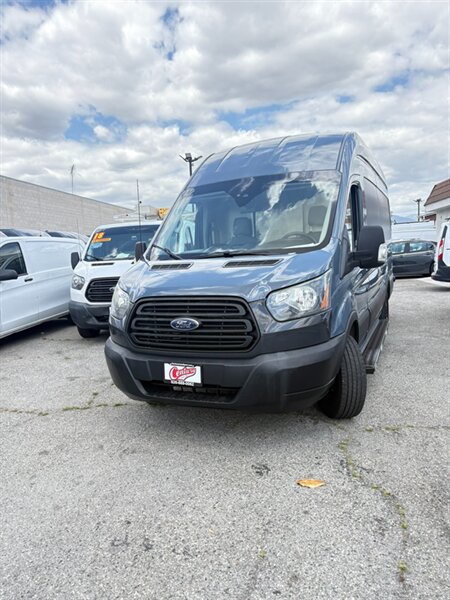
- If crews will work inside the van — picking parts, assembling fittings, using a bench — yes, and it is the single most valuable option on the vehicle. If the van is purely a container that is loaded and unloaded from outside, a Medium or Low Roof saves money and fits more parking structures. Measure your garage and depot clearances before deciding.
- What is the difference between a T-150, T-250 and T-350?
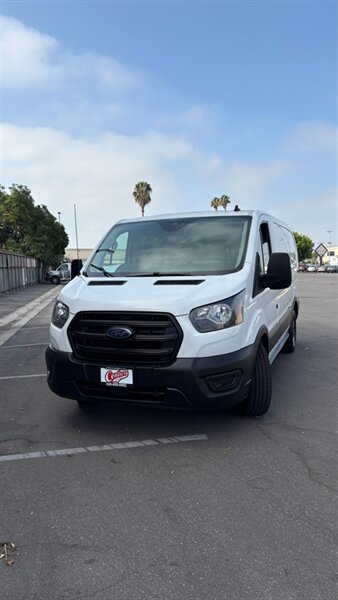
- Series denotes weight rating. The T-150 is the lightest and cheapest with the least payload; the T-250 is the common middle choice; the T-350 and T-350 HD carry the most and are the right answer for heavy trades such as HVAC. They can look identical from outside, so confirm the series on any listing rather than judging by appearance.
- Does a Ford Transit need a commercial driver’s licence in California?
- A standard Transit is rated well below the 26,001 lb GVWR threshold that generally triggers a commercial driver’s licence requirement, so a normal Class C licence is typically sufficient. Requirements change with towing and with certain passenger configurations. Confirm your specific situation with the California DMV and FMCSA rather than relying on a general answer.
- Is the EcoBoost engine worth it for a work van?
- For a consistently loaded van, for towing, or for routes with sustained grades, yes — the turbocharged V6 holds speed on hills without labouring and is more pleasant to drive loaded. For a lightly loaded urban van the naturally aspirated V6 is adequate and cheaper to buy.
- How does the Transit compare with a Ram ProMaster?
- The ProMaster is front-wheel drive with a notably lower load floor, which reduces lifting strain in high-stop-count delivery work. The Transit offers more series and roof combinations, higher towing ratings and a deeper upfit ecosystem. For hand-loaded delivery the ProMaster’s floor height is a genuine advantage; for mixed trade work the Transit’s configuration range usually wins.
- How does the Transit compare with a Mercedes-Benz Sprinter?
- The Sprinter generally rides better on long routes and supports the most specialised upfits, particularly refrigerated and medical conversions. It also costs more to buy and to service, and parts availability is thinner outside metropolitan areas. For most Southern California trade fleets the Transit is the more economical answer; for a specialist conversion the Sprinter often is not beatable.
- Should I buy a new or used Transit?
- Used Transits are plentiful because so many were sold into fleets, and ex-fleet vans often come with documented maintenance histories that private sales do not. The risk is the upfit rather than the mechanicals — check roof penetrations, previous shelving mounts and door mechanisms. A well-maintained used van with the right series usually beats a new van in the wrong one.
- Can a Ford Transit tow?
- Yes. Published towing ranges from about 4,700 to 7,500 lbs depending on configuration and equipment. As with payload, the rating that applies is the one for the specific van, and towing capacity and payload interact — loading the van heavily reduces what it can safely tow.
- What is the difference between a Transit Cargo, Crew and Cutaway?
- Cargo is an empty box with two seats. Crew adds a second row of seats with a bulkhead and a smaller cargo area behind. Cutaway is a cab on a bare frame, supplied without a rear body so an upfitter can fit a box, service body or specialty conversion.
- How long do commercial upfits take?
- Straightforward shelving packages are often days once the van is available. Specialty conversions can run to months. The practical advice is to order the body or upfit at the same time as the chassis rather than after it arrives, because upfitter lead time, not chassis supply, is usually what delays a van entering service.
- Is the electric E-Transit a sensible replacement?
- For fixed routes under roughly 100 miles a day that return to the same yard each night, it can be. The decisive questions are real-world range when fully loaded in summer heat, whether depot charging exists or must be built, and payload after battery weight. It is not a like-for-like swap for a van that roams unpredictably across the region.